
Users are trying a new product and getting to value faster than ever. That first “oh, this actually works” feeling, which used to take days of setup and onboarding, is now happening in the first session, sometimes in the first few minutes.
AI is doing for activation what mobile did for distribution: compressing the time between intent and outcome in a way that makes the old playbook feel irrelevant.
But here’s something that ChartMogul’s research has started to surface, and that many SaaS teams haven’t fully reckoned with yet: the AI-native products that are growing the fastest are also, in many cases, churning the fastest. Some are 3x more likely to reach $1M ARR in six months. They’re also showing weaker net revenue retention than their traditional SaaS counterparts.
That’s a tension worth sitting with. Fast early growth. Weak retention. What’s going on?
The answer isn’t that AI is bad for retention. It’s that AI is changing what activation actually means and most products haven’t caught up to that change yet. They’re measuring it the old way while the ground has shifted.
Why Activation Is Harder Than It Looks Right Now
For most of SaaS history, the activation problem was straightforward, even if solving it wasn’t: users had to get through setup before they experienced value, and too many dropped out during that phase.
The fix was to shorten and simplify setup—better onboarding flows, fewer required fields, faster time-to-first-value.
AI has largely solved that problem. You can now sign up for a product, describe what you need, and receive something useful in under a minute.
The empty-state problem—that hostile blank canvas you used to face on day one—is disappearing. Products are generating first outputs, pre-populating environments, and guiding users through natural conversation rather than step-by-step tutorials.
This is genuinely good. Faster time-to-value is real progress.
But it’s created a subtler problem that’s harder to see in a dashboard: when AI delivers value immediately, it’s doing the work that the user used to do and that work had a side effect nobody talked about. It built understanding. It built a mental model of the product. It created the cognitive foundation that makes people come back.
When AI skips that friction entirely, users experience value passively. They’re impressed. They may even tell someone about it. But they haven’t integrated the product into how they actually work and without that integration, the next time they need to solve the same problem, there’s no strong reason to return to you specifically.
THE SHIFT HAPPENING RIGHT NOW
- Old activation problem: Users dropped off before reaching value. Time-to-value was too long.
- New activation problem: Users reach value quickly but passively. First impressions don’t compound into habits.
Most activation dashboards are still measuring the first problem. The second one shows up in your churn data six weeks later.
What the Best AI-Native Products Are Actually Doing
There are four patterns emerging in products that are getting AI-driven activation right. They’re not evenly distributed, most products have adopted one or two. The ones with compounding growth have all four.
Pattern 1: AI-Generated First Outputs
Instead of starting users with a blank canvas, the best products generate a first working artifact immediately. A presentation. A CRM pipeline. A draft document. Something the user can react to, edit, and make their own—rather than build from scratch.
Gamma is the clearest example of it. When you sign up, you describe what you want to create and receive a fully styled presentation within seconds. You’re not starting from zero, you’re starting from a response. That shift is enormous for perceived value.
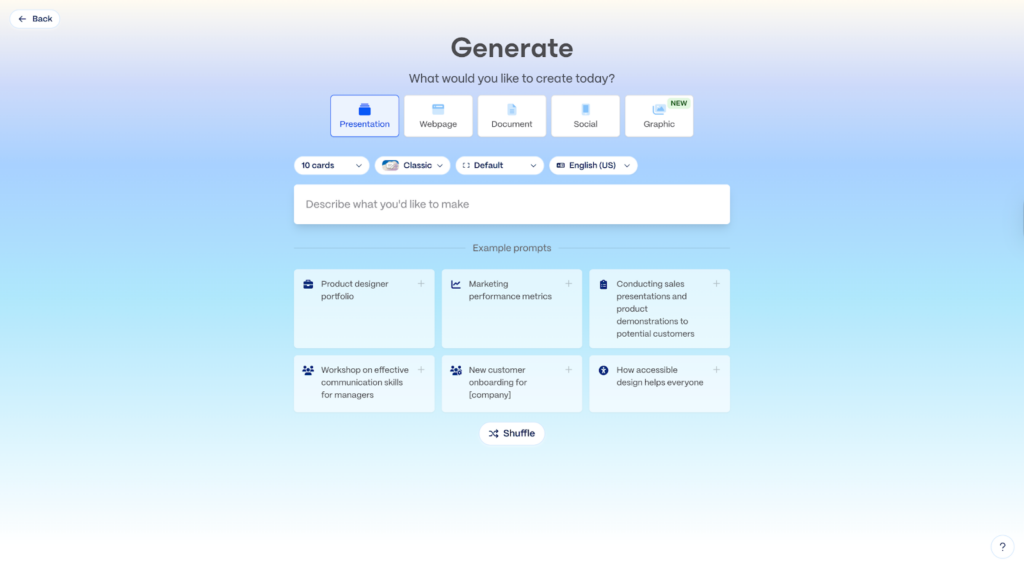
What makes this work isn’t just speed. It’s specificity—an output that feels tailored to what the user actually described creates a different psychological response than one that feels templated. The user thinks: this understood what I needed. That moment of recognition is what makes them want to keep going, and come back.
Pattern 2: AI-Assisted Setup
In most SaaS products, value is gated behind configuration—connecting tools, importing data, building workflows. This is where momentum breaks. Users who sign up intending to try something run out of patience before they experience anything worth staying for.
AI removes this gate. HubSpot uses AI to generate CRM pipelines from minimal input. Intercom builds help centers and bots from existing content. The product creates a working starting environment so users can skip configuration and enter the value phase directly.
The principle: Setup isn’t eliminated. It’s shifted from user effort to model inference.
Pattern 3: Conversational Onboarding
Traditional onboarding is a fixed flow: Step 1 → Step 2 → Step 3.
Conversational AI replaces it with adaptive dialogue—the product asks simple questions and responds to answers in real time, moving users toward value through conversation rather than a predetermined script. In this sense, onboarding stops being a flow and becomes a feedback loop. Done well, this captures something that forms and tutorials never could: real user intent. Not just what they typed into a field, but what they’re actually trying to accomplish, for whom, and in what context. The better the product understands that context, the more useful every subsequent AI interaction becomes.
Notion’s AI assistant is a strong example. It doesn’t explain itself upfront, it helps users do things as they go, responding to what they’re working on rather than guiding them through a predetermined path.
Pattern 4: Context-Aware AI Inside the Workflow
The most durable pattern isn’t about the first session at all. It’s about what happens inside the product over time. The best AI-native tools become more useful the more you use them, because they accumulate context: your preferences, your project history, your way of working.
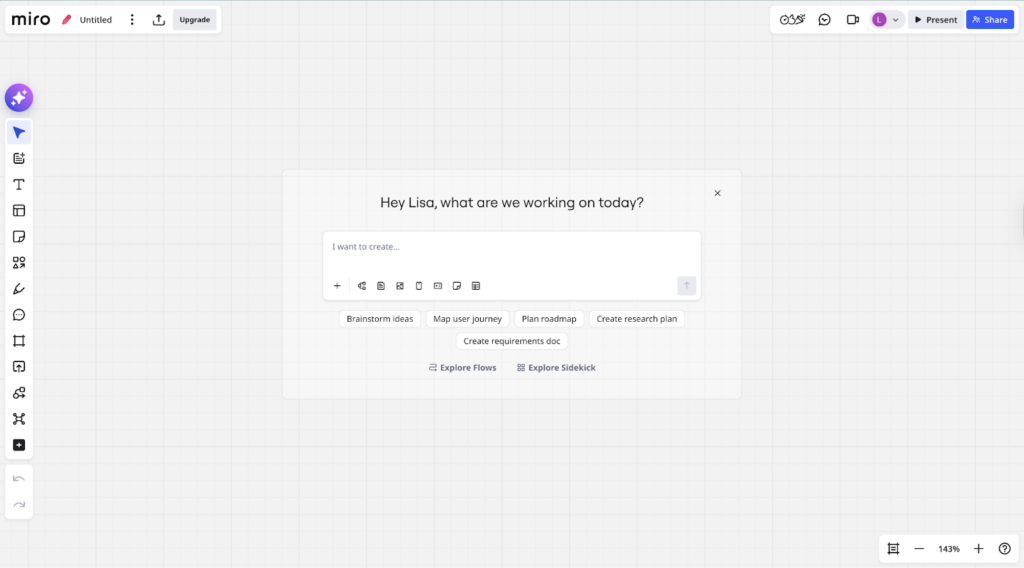
Miro’s AI is a good example. It understands what’s already on the canvas. It doesn’t introduce a new flow—it works on top of what exists, summarizing, clustering, generating from context. The AI isn’t a feature you visit. It’s embedded in how the product works.
This is the pattern that creates genuine retention. Each use makes the product more valuable. Each use also makes leaving more costly, because what you’d lose isn’t just a tool—it’s accumulated context that took time to build.
The Gap Most Products Are Missing
Here’s the thing about those four patterns: they all solve the entry problem elegantly. They compress the time between signup and first value. They make the first session impressive.
What they don’t automatically solve is what happens next.
Think about the user journey this way. There’s a difference between a user who generated a Gamma presentation, was impressed, and closed the tab and a user who generated that presentation, edited it, shared it with their team, and came back the next week to build another one. Both users are “activated” by any standard dashboard definition. Only one is a retained user.
The first user experienced something like a demo. The second integrated the product into how they work. That gap is where most AI-native products are quietly losing revenue and it doesn’t show up until you look at 60-day retention curves rather than week-one activation rates.
Or as I like to say: “The fastest path to first value isn’t the same as the shortest path to a durable habit.”
What creates the difference? Three things, consistently:
Whether the user acts on the output, not just receives it. A user who edits, shares, exports, or applies what AI generated has crossed a threshold. They’ve made the output their own. That crossing—from passive recipient to active user—is the moment where value becomes real rather than impressive.
Whether they have a reason to return. This sounds obvious but almost no one designs for it explicitly. What is the specific, concrete event that brings this user back tomorrow?
For Loom, it was someone watching your video. For Slack, it was a conversation waiting for you. For Cursor, it’s your codebase living inside the product. The return trigger needs to be built—it doesn’t appear on its own.
Whether the product accumulates context over time. Traditional SaaS created switching costs through data: your files, your contacts, your history. AI-native products need to build the equivalent deliberately. The product should know more about you—your preferences, your patterns, your team—with every session. That accumulation is what makes leaving genuinely costly.

What This Means for Your Metrics
Most SaaS teams track activation as a binary: did the user reach the key milestone or not? That works fine when activation is the hard problem. When the hard problem shifts to retention quality, you need metrics that see further into the user journey.
Three additions that most teams aren’t making yet, and that will tell you more than your current activation rate:

These three metrics together tell a story that activation rate alone can’t: not just whether users are reaching value, but whether that value is sticking.
What to Do Differently Starting Now
None of this requires rebuilding your product. It requires sharpening what you’re focused on.
Redefine your activation event. If your current activation milestone is “completed onboarding” or “generated first output,” you’re measuring a moment that precedes value, not one that proves it. Add a downstream action requirement—the user edited, shared, applied, or returned to the output. Your activation rate will drop. What you’re left with is a cohort that actually predicts retention.
Design the return trigger explicitly. Before your next sprint, answer this question directly: What is the specific, concrete event that brings a user back to your product tomorrow? If the answer is a vague “because it’s useful” you haven’t designed a trigger. You’ve hoped for one. Return triggers are specific: a notification, a collaboration ping, a saved project waiting, a result that arrived. Build the one that fits your product.
Look at where context accumulates. Trace the user journey and ask: at what point does the product start knowing something meaningful about this user that it didn’t know before? If that point is far into the journey, or doesn’t exist, you’re not building the switching cost that creates durable retention.
Separate your cohorts. In your analytics tool, build two cohorts: users who took a downstream action on their first AI output, and users who didn’t. Look at their retention at 30, 60, and 90 days. The gap between those curves is your activation opportunity and it’s usually larger than teams expect.
The New Activation Standard
AI has fundamentally changed what’s possible in the first session. Strong first outputs, self-building setup, and onboarding that adapts to what users actually say they need are real improvements. Products that haven’t adopted them are already behind.
But a great first session is now table stakes. The companies that compound growth over the next few years won’t be the ones with the slickest AI onboarding. They’ll be the ones that turn early value into lasting workflow habits and build their metrics, product choices, and growth bets around that full journey.
The ChartMogul data hints at what comes next. Fast early growth that never compounds into strong NRR isn’t a growth story. It’s an acquisition story with a retention problem. Closing that gap starts with redefining activation.
“The fastest product to deliver value gets a foot in the door. The product that becomes part of the user’s workflow is the one that stays.”
Lisa Heiss is a PLG and activation strategist & the founder of UXELERATE, working with B2B SaaS founders from Seed through Series B on activation, conversion, and retention architecture.
