
LLM Pulse helps companies navigate and succeed in AI search across platforms such as ChatGPT, Gemini, and Perplexity.
The company launched in July 2025 as a simple ChatGPT tracking tool, inspired by the founders’ experience working in SEO. One year later, it had evolved into an end-to-end AI search platform with hundreds of customers and more than 3,000 product commits, all while remaining bootstrapped and operating with a three-person team.
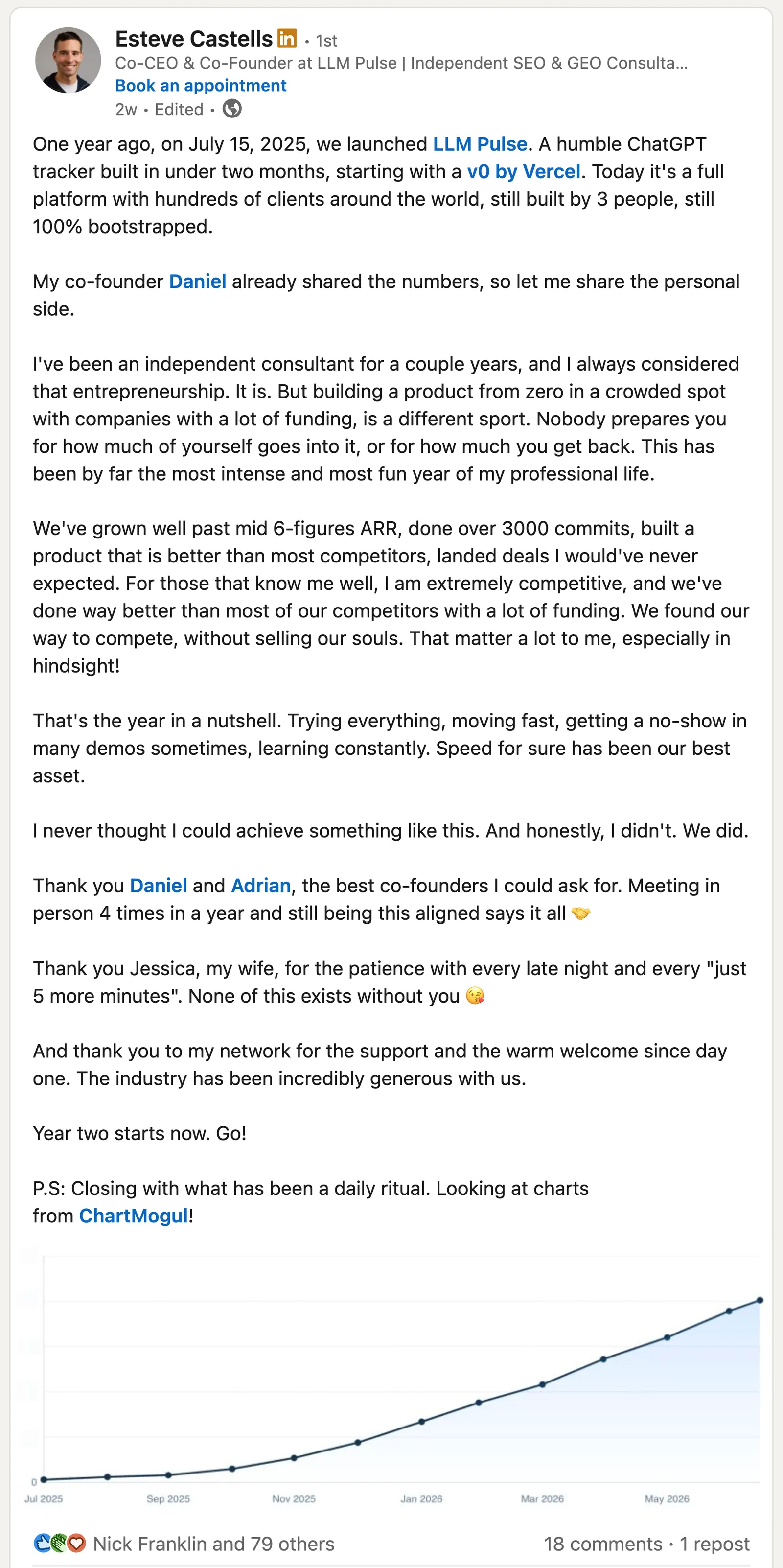
For co-founder Esteve Castells, speed has been the company’s strongest advantage. LLM Pulse entered a crowded market alongside venture-backed startups, established SEO platforms, and enterprise software companies. They pulled ahead of the competition by getting feedback from customers and shipping quickly. But that only worked because they also knew what not to build.
Combining AI speed with SaaS discipline
LLM Pulse sees itself as a hybrid between a native AI company and a traditional SaaS business.
Agents and AI-specific functionality allow the team to build and iterate unusually quickly. At the same time, the founders still rely on classic SaaS metrics such as MRR, ARR, NRR, and churn to understand the health of the business.
They regularly analyze those metrics across dimensions such as plan type and country, giving them a clear picture of where growth is coming from and where performance may be changing.
ChartMogul has been part of that operating discipline since the beginning.
Esteve’s co-founder, Daniel, had used ChartMogul at a previous SaaS company and understood the value of putting reliable revenue infrastructure in place early. For Esteve, a first-time SaaS founder, it provided a clearer way to understand what was happening in the business rather than piecing it together from raw Stripe data.
Why LLM Pulse left subscription logic to the experts
Building LLM Pulse gave Esteve a firsthand view of how quickly billing complexity compounds.
The company processes Stripe data directly, and its internal parser has already grown to around 4,000 lines of code. The team continues to add new logic as it encounters different billing scenarios and edge cases.
Subscription analytics adds another layer of complexity.
Cancellations, reactivations, refunds, failed payments, plan changes, billing intervals, and scheduled changes all need to be interpreted consistently. Even small errors can compound over time and distort the metrics a company relies on to make decisions.
LLM Pulse knew it could build an analytics interface quickly. But recreating and maintaining the logic behind accurate MRR, churn, retention, and customer histories would pull its engineers away from the problems at the heart of its product.
We could probably ship a clone of ChartMogul in a day, but all the metrics would be wrong.
ChartMogul became a deliberate exception to the company’s preference for building software internally.
It offloads the complexity of turning billing activity into accurate SaaS metrics, while allowing the team to keep its own engineering effort focused on AI search.
Bringing all recurring revenue into one view
Most customers pay through Stripe, but around 5% are larger accounts billed by bank transfer, often under more customized commercial agreements. LLM Pulse imports both revenue streams into ChartMogul.
ChartMogul is the place where we consolidate everything and have one single source of truth.
ChartMogul acts as an abstraction layer over the underlying billing data. The founders can monitor growth and subscription performance without first reconciling multiple systems or manually checking whether the numbers can be trusted.
The team uses ChartMogul daily to monitor new business, keep churn data current, track invoices, and understand upcoming subscription changes. They also break performance down by plan and country to see which parts of the business are contributing to growth.
The CRM capabilities a three-person team actually needs
ChartMogul gives LLM Pulse one place to manage customer, revenue, and commercial information.
The founders use it to record whether a customer came through Esteve, Daniel, or self-service, keeping attribution tied directly to the revenue it generates.
We keep our core business metrics there, including who brought in a sale, whether it was me, Daniel, or self-service.
For larger customers billed by bank transfer, they can also add notes and follow-up tasks alongside the account’s subscription history.
We don’t have a CRM, to be completely honest. We use ChartMogul as a kind of CRM and as our source of truth.
For a three-person team with a largely inbound, product-led motion, that covers what they need. Everyone can see how an account was acquired, how it is performing, and what follow-up is required.
A more traditional CRM would add cost and administration without solving an immediate problem. ChartMogul gives LLM Pulse enough structure to coordinate sales activity without introducing another major platform.
Knowing whether fast growth is really exceptional
LLM Pulse is growing quickly, but the founders wanted a clearer sense of what that growth meant in context.
The company sits somewhere between traditional SaaS and a newer generation of AI businesses, where there is less of an established playbook for what good growth looks like. ChartMogul’s SaaS benchmarks let the team compare LLM Pulse with companies at a similar stage and see how growth rates change as they scale.
We like to see where we land in terms of the industry. It pushes us to do better and helps us understand whether we have an attractive growth rate.
Esteve estimated that LLM Pulse ranked somewhere between the top 10% and top 25% of SaaS companies in the benchmark data, giving the founders both an objective view of their performance and another target to push against.
Adding structure without slowing down
As LLM Pulse grows, its revenue and customer relationships will become more complex. ChartMogul gives the founders the structure to manage that complexity without turning it into another engineering project.
The team can trust its subscription metrics, keep customer and commercial context connected to revenue, and bring different billing methods into one place.
LLM Pulse can add more structure and discipline around the business while keeping its engineers focused on the customer problems that make the product competitive.
We always knew we would either use ChartMogul or build it ourselves. Not building this in-house made so much sense.