
The comeback of a SaaS pioneer
Buffer is a social media toolkit for creators, entrepreneurs, and small businesses. Their approach to sustainable growth, transparent salaries, remote work, and content-led marketing helped pioneer many practices now common across SaaS.
One of Buffer’s core values is to default to transparency. The company openly shares its revenue and customer metrics. It also explains the thinking behind major decisions, from how it hires to what it learned launching a new product and introducing a four-day workweek.
Without pressure from a board or outside investors to pursue growth at all costs, the momentum to keep building has to come from within the team. With fewer than 100 employees, each person needs to align with the culture and believe in the mission.
We first profiled Buffer in 2019, when the company reached $20M in ARR and was using ChartMogul as a core part of its revenue data stack. But even with the right systems in place, growth is rarely a straight line, and no company can expect its metrics to rise indefinitely.
Rebuilding Buffer’s growth engine for a new era
As Buffer grew, their focus shifted from small creators to direct-to-consumer brands. They became multi-product, growing average revenue per user (ARPU) through upsells. The tradeoff seemed acceptable: fewer customers, provided ARPU continued to rise. But the number of customers just kept dropping.
By 2022, Buffer was in their third year of decline, with MRR down 7.57%, a $573K net loss, and 21 months of runway.
Looking at the data in ChartMogul, Buffer saw that during earlier periods of growth, customer growth had outpaced ARPU growth. Sticking with the strategy to grow by increasing ARPU would mean having to continually raise prices, a model used by enterprise SaaS companies.
Instead, Buffer returned to the mission it had started with: supporting small creators and entrepreneurs. Its new strategy would focus on attracting more downmarket customers and growing through new users.
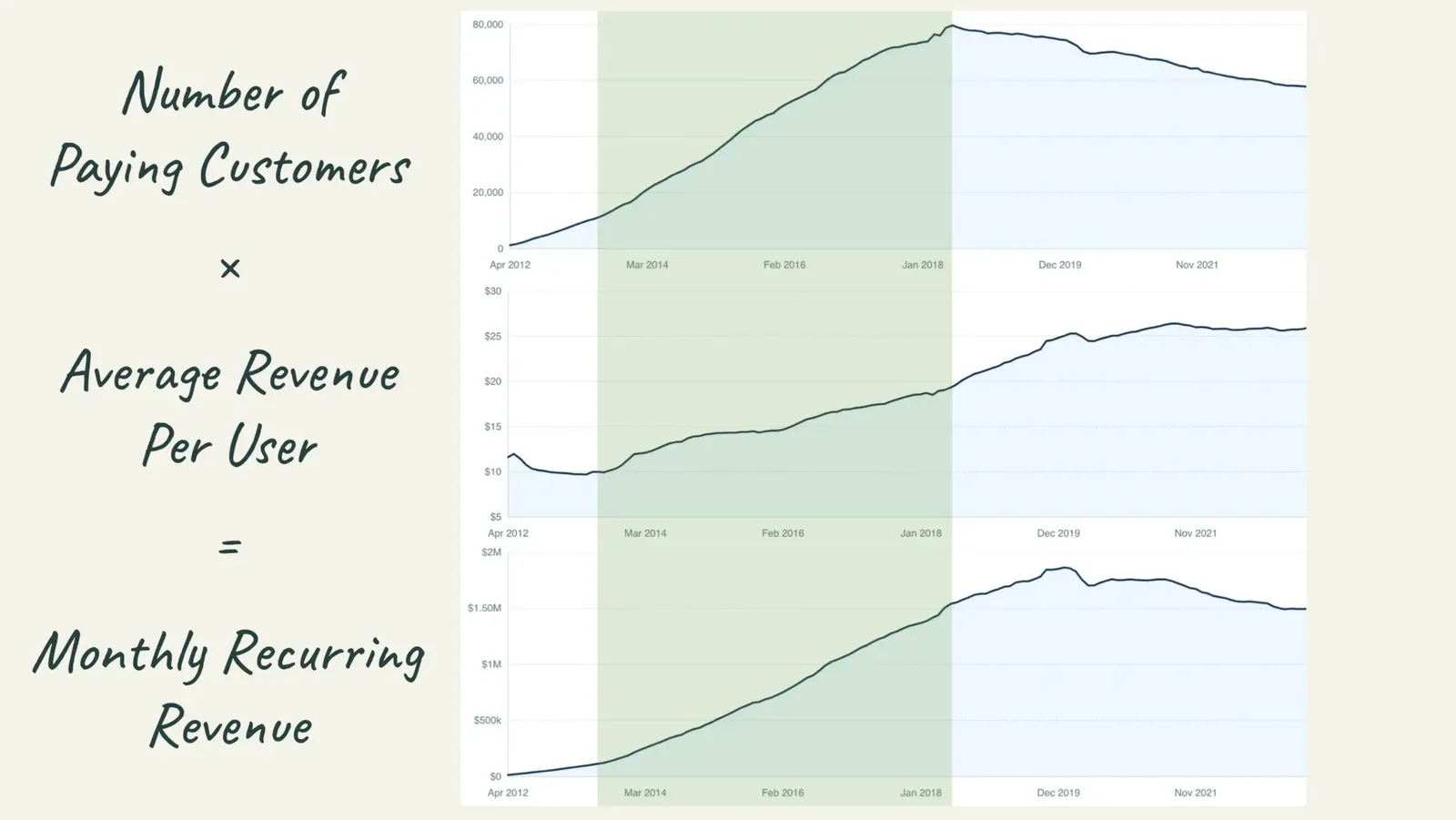
To help turn the business around, the team needed to rebuild how the company approached growth. Part of that was bringing on Simon Heaton as Senior Director of Growth Marketing and Data, whose remit was to help identify and scale the company's organic growth engine, without relying on expensive paid acquisition.
“SEO and content marketing were a huge part of how Buffer grew in the past,” he explains. “But we had to reignite content marketing and be much more deliberate about creating content that builds awareness.”
That renewed focus on awareness extends beyond the marketing team. Around 90% of Buffer’s employees regularly share what they’re building, designing, and solving, using Buffer itself to plan and publish much of that content.
People go on LinkedIn and X and Threads and talk about what they're building, what's going on at Buffer, to start to build more awareness of the brand. We see a lot of our high quality audience coming from those channels. And that's allowed us to garner millions of impressions for pretty much free.
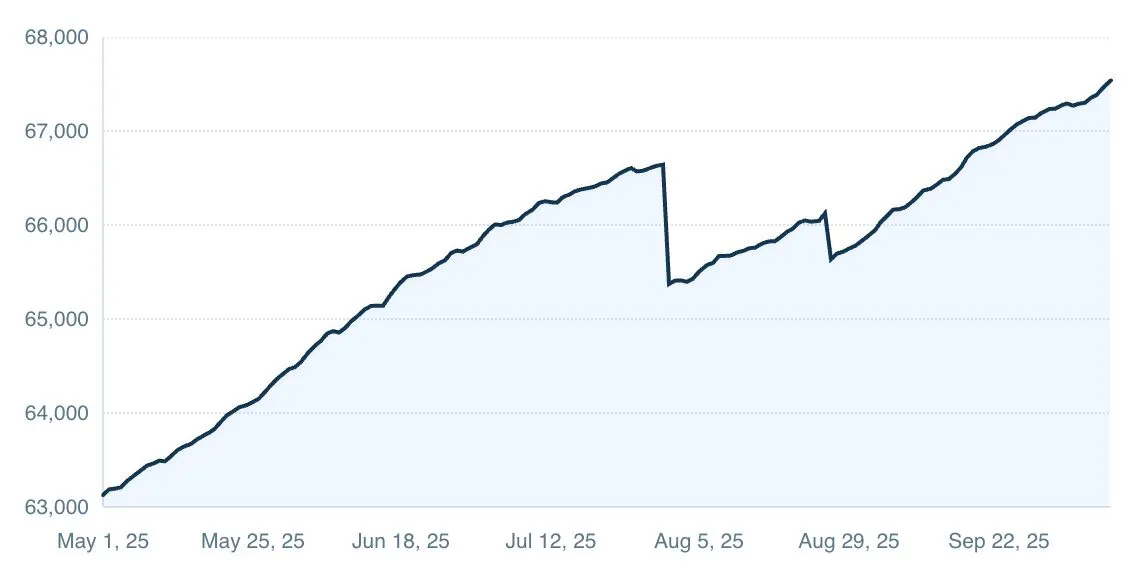
Building a strong product can drive word of mouth, but so can demonstrating the values behind the brand. In 2025, Buffer announced that it would automatically cancel 1,200 inactive accounts before renewal, taking an intentional hit of $14,000 MRR. The decision struck a chord, prompting others across SaaS to share and celebrate Buffer’s approach.
 Joel Gascoigne @joelgascoigne
 This is one of my favorite charts at Buffer right now.
It's the chart of our number of paying customers. And it might look like we've just experienced some awful churn, but that's not what it is.
Those drops in number of paying customers are when we proactively cancelled... Show more
As an extension of its SEO strategy, Buffer also invested in answer engine optimization to reach its core market. Today, more than 40% of their leads come via ChatGPT.
Buffer also launched a Discord server to build a closer relationship with its customers. The 10,000-member community is the first to hear about new features and provides feedback that helps shape the product. Some of its most engaged members have also become natural advocates for Buffer and its launches.
We have a couple community members who have become so involved with Buffer that they're also just naturally promoting our launches. That type of evangelism is amazing and has been a huge part of reigniting that organic flywheel.
Buffer’s MRR bottomed out at roughly $1.5M. Since then, its renewed focus on brand awareness and independent creators has helped support a strong recovery. Today, the company serves nearly 80,000 paying customers and has reached an all-time high of $26M ARR, or approximately $2.1M MRR.
All these things center around Buffer's brand: the culture, the people who work there, the decisions we make. We try to optimize for value creation over value extraction. And we even think about growth internally as value-led. And so that core part of Buffer, and that brand, is our biggest growth asset and loop that we have. One of the strongest things that I uncovered for Buffer is that we can utilize all these different facets. All that together kind of makes this visibility engine.
Connecting product decisions to revenue
ChartMogul remains an important part of how Buffer monitors the business and decides where to invest next. It sits alongside BigQuery, Segment, Mixpanel, Hex, and Customer.io in the company’s data stack.
We look at everything in [ChartMogul]. A lot of us are in there every day. I know Joel [Gascoigne, CEO] is in there every day. We use it to look at overall recurring revenue health. We distill into segments and tiers and we try to figure out what's actually driving the topline growth. And it's really cool because the layer is interconnected to our modeling for the business. It's been super valuable to build an understanding of how the various pieces lead to subscriber growth. The MRR movement report is my favorite report by far. It helps us conceptualize the moving parts of a SaaS business.
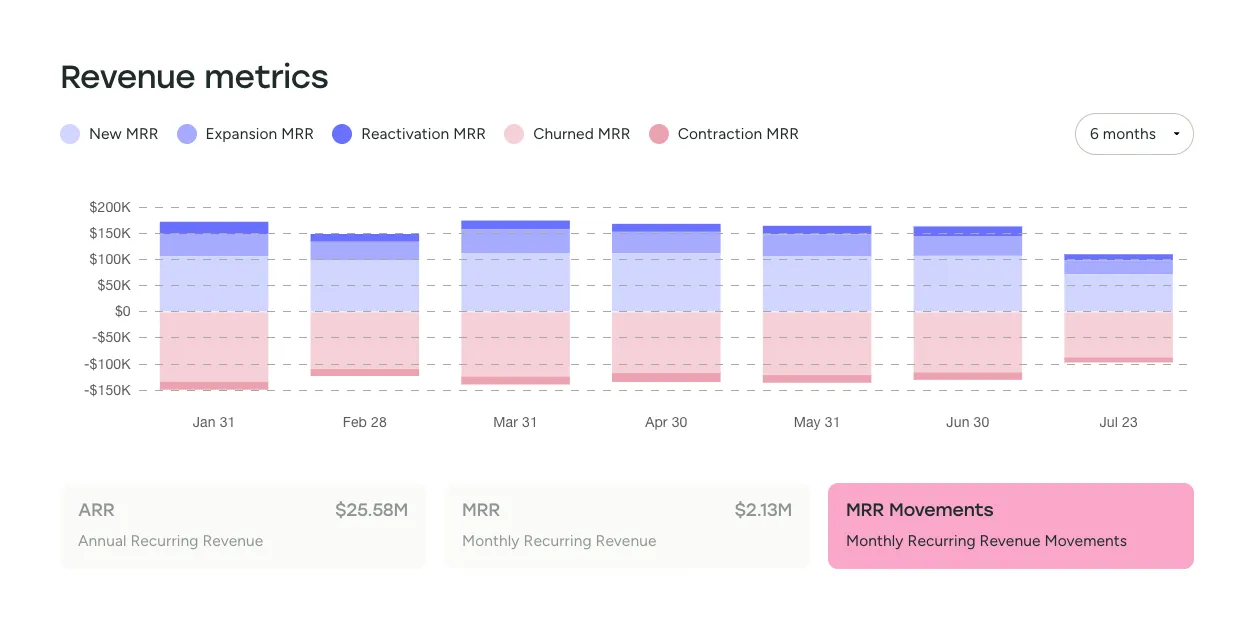
As part of its strategy shift, Buffer consolidated its offering into a single product with one price. Before building a new feature, the team segments its customer base in ChartMogul to understand how different groups behave and assess the potential revenue impact of a launch.
We're still [building for the] down-market but we have mid-market customers that are much higher MRR bands than our average user. They use the product slightly differently and they have different needs. So if we're building for them, we recognize that the adoption might not be to the same degree as a down-market focused feature because there's a smaller cohort there, but the revenue or retention of that revenue associated with the individuals who will use that feature is much higher.
Buffer primarily drives expansion when customers add more social media channels to their accounts. ChartMogul helps the team see which customer segments are generating that expansion and how their retention patterns differ.
When Buffer runs an experiment, the team can examine the resulting MRR movements in ChartMogul. Connecting those results back to revenue helps it evaluate hypotheses and decide where to dedicate time and resources.
We always want to be able to tie [tests] back to [understanding] ‘how much [revenue] did this actually yield?’ That's where ChartMogul comes in. A lot of these tools are pretty interoperable. So we can either pull that data all into Hex or we could pull it into Claude and analyze from multiple sources. And that's been super powerful to inform us of where the opportunities lie.
Buffer’s return to growth wasn’t the result of a single channel, feature, or campaign. It came from reconnecting its brand, product, community, and growth strategy around the customers it originally set out to serve.
ChartMogul gives the team a clear view of how those product and growth decisions show up in revenue, but the larger lesson belongs to Buffer: after 16 years, staying relevant means knowing what to preserve, what to rethink, and how to make the two reinforce each other.