
Spending time with customers is one of the best reasons to pack a bag. What are they working on? What’s getting harder? What matters to them that we’re missing?
The idea for the PLG Growth Lab roadshow started last October. I was a little tired of hearing headline stories of unicorns from speakers far removed from the day-to-day work. I wanted to hear from people still figuring things out, whether that’s how product marketing is changing with AI or how to compensate sales reps on usage-based pricing.
Those are the conversations I have with ChartMogul customers all the time. I wanted to get those people in a room together. That became ChartMogul’s PLG Growth Lab: seven stops in San Francisco, Šibenik, Paris, London, Warsaw, Utrecht, and New York.
Every city took on a life of its own. In Warsaw, we discussed AI pricing in an old movie theater while everyone ate popcorn. In Utrecht, people braved serious rain to discuss building a new product category. In Paris, we talked activation and AI on a rooftop with the Eiffel Tower sparkling in the distance.
From workshops and panels to rooftop drinks and a dinner to finish, what made each stop worthwhile was how openly people shared, including the things they hadn’t figured out yet.
San Francisco: from individual users to bigger teams
We kicked things off during Stripe Sessions with Brenna Loury, CRO of Doist, for a boardroom workshop on moving upmarket.
Seeing a household-name company sign up for your product is exciting. But one person using an entry-level plan is a long way from an enterprise deal. How do you turn that early interest into broader adoption and a much bigger contract?
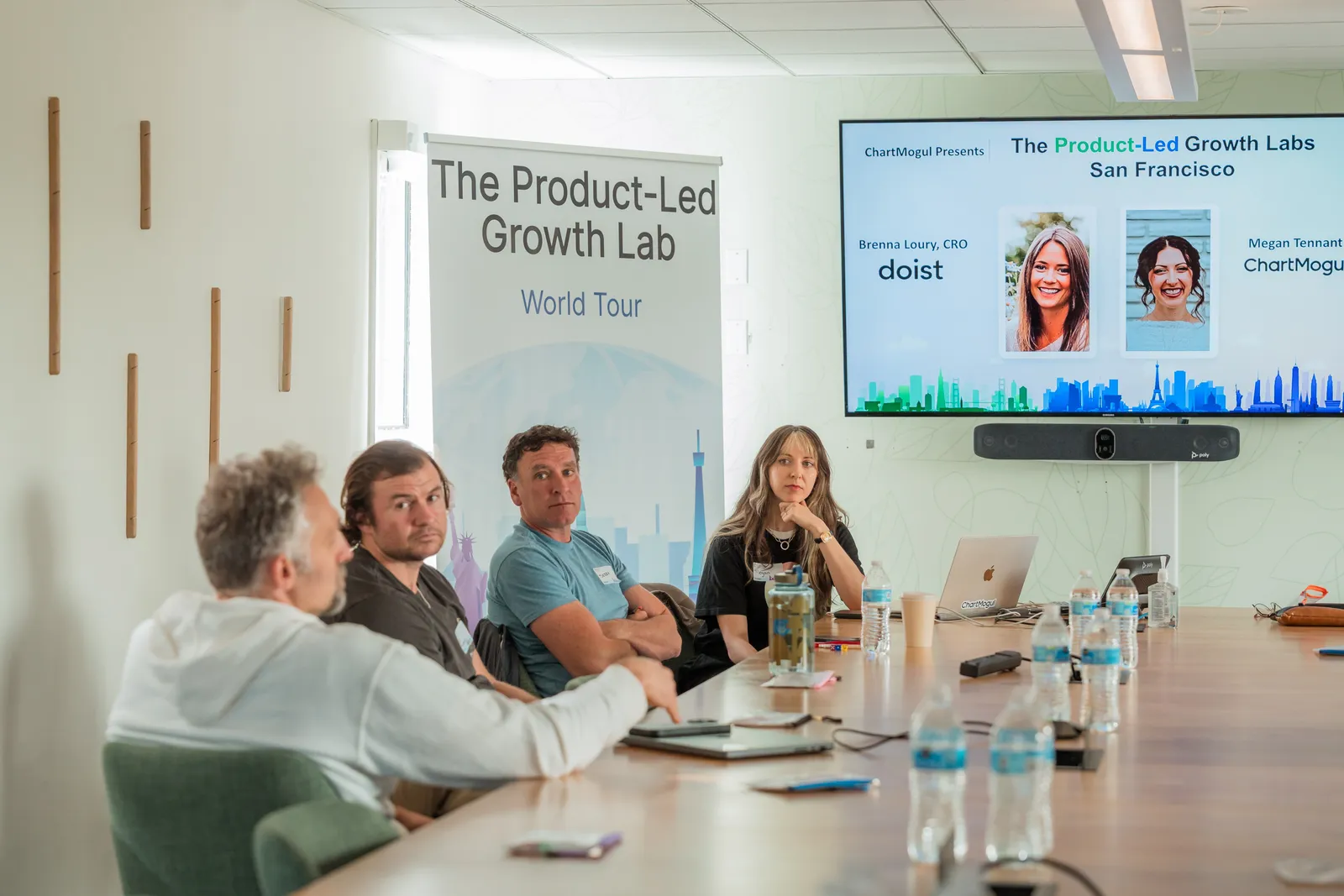
That was the heart of our discussion: knowing when to involve sales, helping an individual user build support internally, and building a team that can close those deals. It’s a challenge many product-led businesses face as their ambitions grow beyond individual signups.
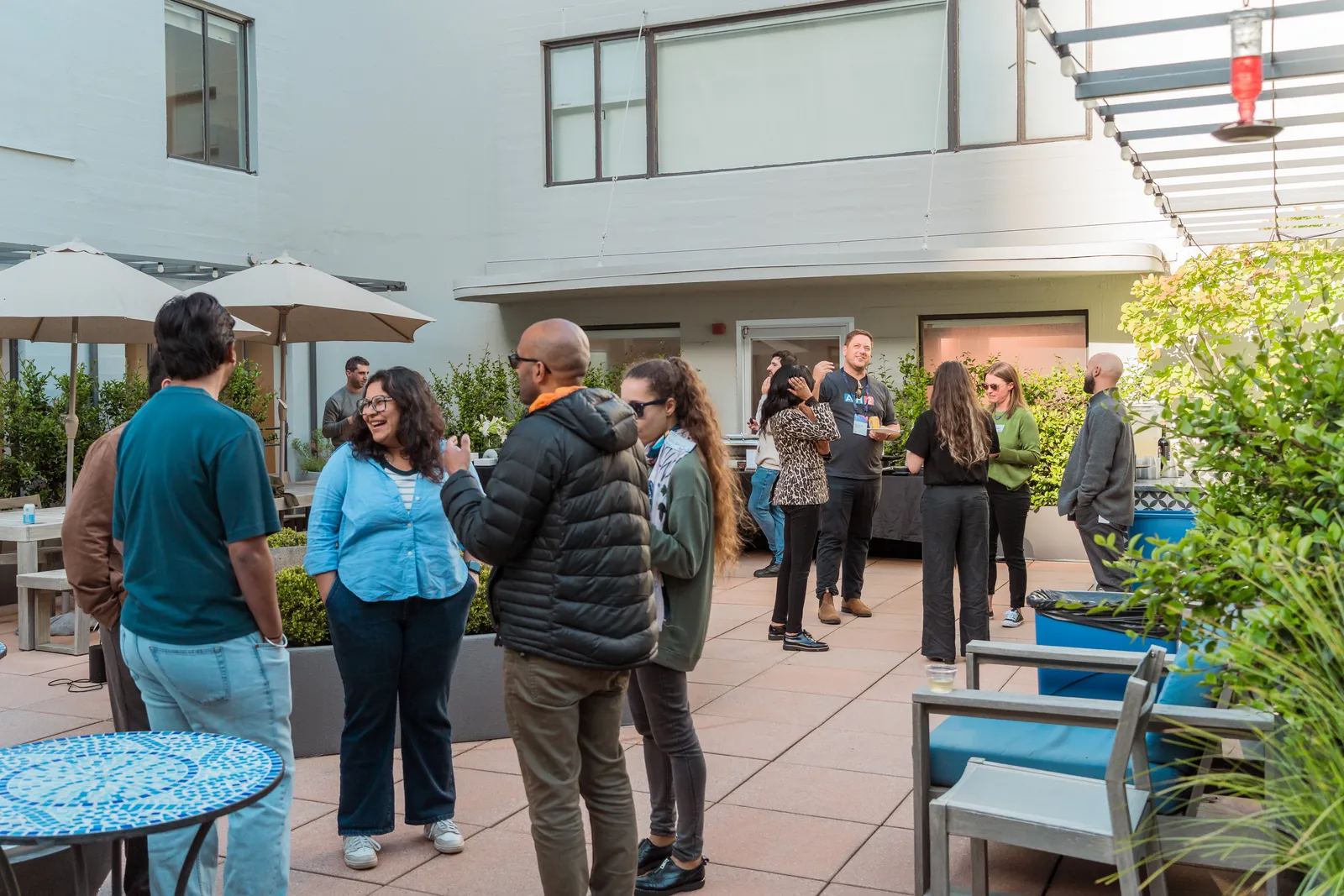
Brenna was candid about those challenges, and everyone brought their own experience. We were still deep in conversation when it was time to head upstairs, so we continued over rooftop drinks.
Šibenik: getting into the mechanics of growth
Our next stop was the Croatian coast, where we partnered with SaaStanak for two afternoons of PLG content. The sessions were standing room only during a heat wave but the views were immaculate and the location superb.
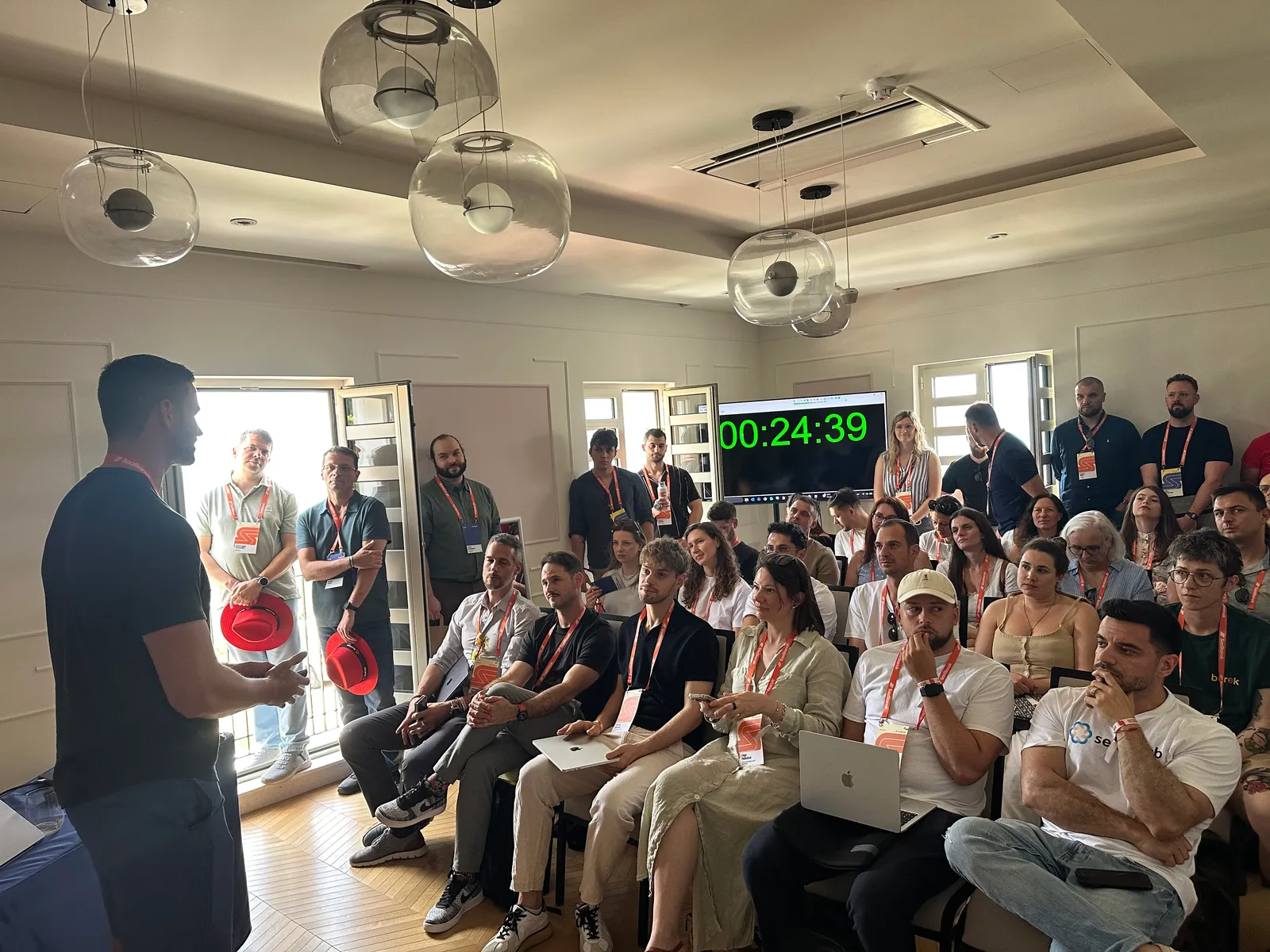
This was our deepest dive into the operational side of product-led growth.
Tom Andrews showed what needs to happen behind an automated upsell: connecting product usage, customer, and billing data with a live demo. Aleksandra Korczyńska explored what behavioral data leaves out. Knowing that someone didn’t upgrade doesn’t tell you whether they’re missing a feature, waiting on budget, or struggling to get started. Sometimes it’s best to ask directly.
Activation came up from several angles. Wes Bush challenged teams to think about what their product could do for someone before asking them to learn the interface. Paulina Spaccarotella looked at the experience through the user’s eyes: whether they feel understood, capable, and confident enough to keep going.
Kyle Poyar and I ran a workshop on the growth levers that matter as businesses move from $1M toward $20M ARR. We talked about retention, expansion, pricing, and what has to improve as the company scales.
We published a full recap of the Šibenik sessions, with practical takeaways and presentation decks for anyone who wants to go deeper.
Paris: PLG is rarely as clean in practice as it seems in theory
Guideflow hosted our Paris stop with views of the Eiffel Tower and, naturally, a DJ. Lisa Heiss and Benjamin Cahen joined me to talk activation, monetization, and how AI is changing the product experience.
Benjamin, CEO of Wisepops, shared their early experiment to move from self-serve to fully sales-led. Imagine telling your sales team you’re switching off the free trials and freemium signups that supply their leads, and asking everyone to speak to sales instead. That’s an interesting challenge to navigate, both for customers and the team.
These were exactly the kinds of experiments I’d hoped we’d discuss. Growing a business sometimes means taking a big bet, and a small, capable team that understands the reasoning can make all the difference.
Lisa brought another useful perspective to activation in AI products. Speed matters, but so do trust and expertise. When software starts doing more of the work, the experience still needs to help people understand and feel confident in the result. With so much uncertainty and fewer barriers to building software, earning that confidence matters more than ever.
After the panel, we kept talking about what people were building and where they were getting stuck.
London: how do you want to buy?
London brought together an impressive group of founders and revenue leaders from Intruder, Physitrack, CharlieHR, Utility, and others. Honestly, almost everyone in the audience could have been on the panel.
The discussion I found most interesting was about onboarding. Typically, someone signs up for a trial, selects their role and company size from a few dropdowns, and gets put into a fairly linear journey. We surface features and send communications over the course of the trial, hoping we’re helping them find value.
What that overlooks is how differently people want to evaluate and buy. Some want to figure things out themselves, while others would much rather speak to someone.
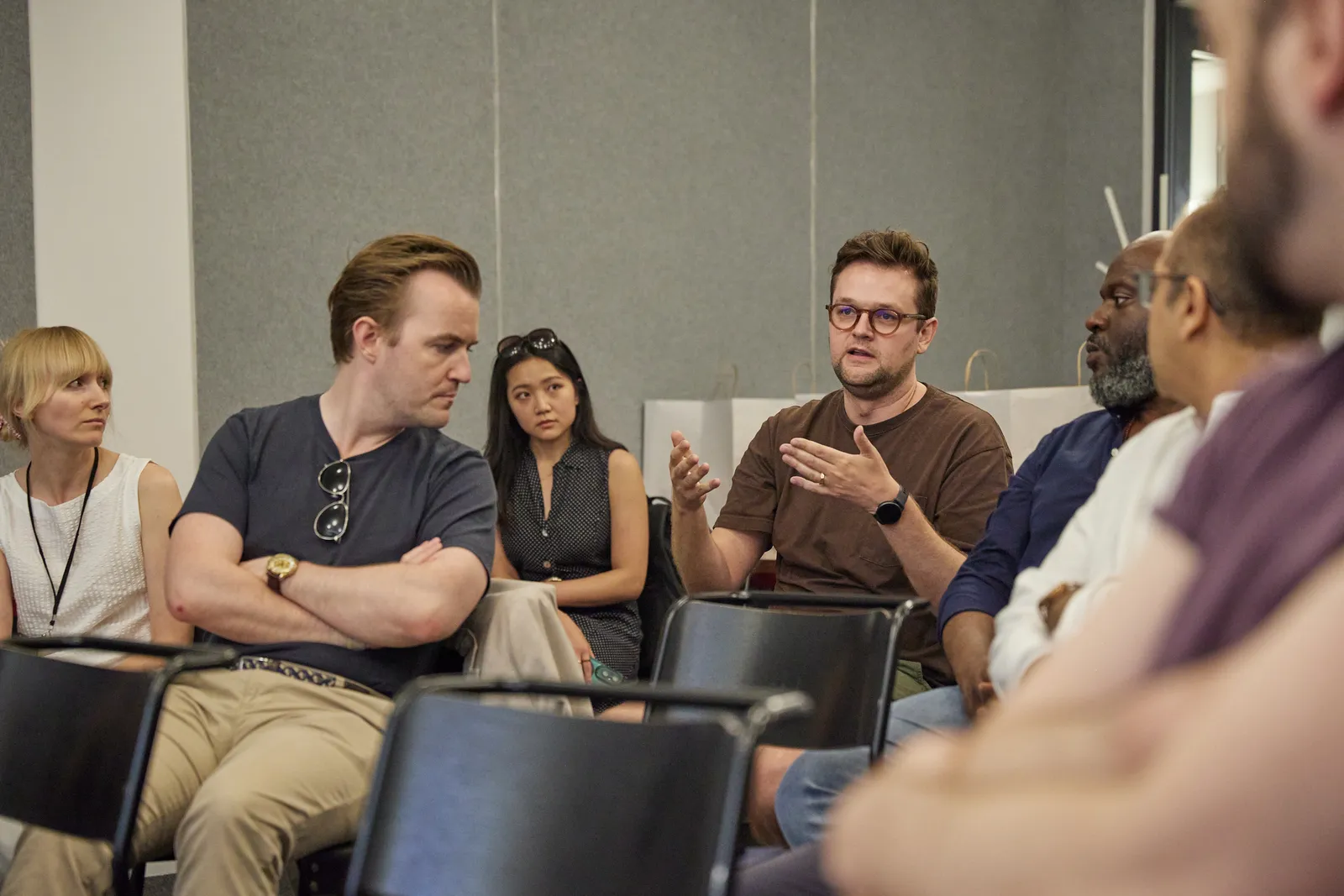
The room laughed when I admitted that the first thing I do is call the number on the website. If I’m a high-intent buyer, I want answers right away so I can make a decision and move on, especially if it’s something I’ve bought before. And moreover, that phone call is quite telling of what the support experience will be like on the backend of a purchase.
We started talking about whether AI could help us capture that intent and offer a more personal experience. What if, at signup, you could explain what you wanted to do and how you wanted to engage? You might want to explore without anyone contacting you, or have a few specific questions for a sales rep before buying.
If the vendor actually listened and shaped the experience around that, we’d all be a little more aligned.
Warsaw: is your AI feature actually working?
Warsaw was my favorite venue of the series: an old movie theater, with everyone eating popcorn while we debated how to measure and monetize AI features. Olga Padulosi and the Survicate team hosted with us, and Piotr Cygan, Krzysztof Szyszkiewicz, Daniel Korczynski, and Wojtek Strzałkowski joined the panel.
One of the most useful discussions was about how you judge whether an AI feature is working. Usage tells you that someone tried it, but understanding whether it delivered something useful means getting closer to the experience: reading actual AI outputs, asking for feedback, and talking to customers about the results.
That led to a broader conversation about product intuition. As building gets faster, there’s still a lot of judgment involved in deciding what to build and what good looks like. You develop that judgment by spending time with users, reading support tickets, investigating bugs, and paying attention to the feedback that doesn’t fit neatly into a dashboard.
We also debated what makes a product difficult to copy. Thoughtful architecture and the ability to deliver value cost-effectively matter, alongside the taste and experience of the people building it. Access to the same AI tools doesn’t mean everyone will build an equally good product.
The audience had plenty to contribute, drawing on years of experience building businesses in Poland’s tech scene. People had questions, opinions, and absolutely no interest in wrapping up on schedule.
Check it out:
Utrecht: how do you explain something new?
Utrecht delivered some seriously intense rain. Thankfully, the Trengo team had us settled neatly into their gorgeous office.
Wolter Rebergen and Claudiu Murariu joined me to talk about attribution and the challenge of marketing a product when the category itself is new. How do you explain what you do when customers don’t yet have a name for it? You can spend a lot of time on positioning and still leave someone wondering whether the product is for them.
On attribution, Claudiu made a point I appreciated: it’s never been easier or cheaper to connect your marketing data to what customers actually do in your product and ultimately pay you. You’re never going to track every recommendation in a WhatsApp group or conversation over dinner. But you can build something consistent enough to make better spending decisions. There’s a point where another hour spent arguing about first touch versus last touch would be better spent doing some marketing.
Claudiu described the series as applying PLG thinking to an event: asking what would make it useful for the people giving us a few hours of their time, then building around that. It was exactly why I’d wanted to do this, and lovely to hear it coming back from someone taking part.
New York: one last dinner
We wrapped up in New York during Pavilion’s GTM Summit, with 18 founders and executives around the dinner table. Some were familiar faces from past events; others were joining us for the first time. Ingmar Zahorsky, our VP of Customer Success, joined too, and it was lovely to spend the evening getting to know everyone and hearing what they were working on.
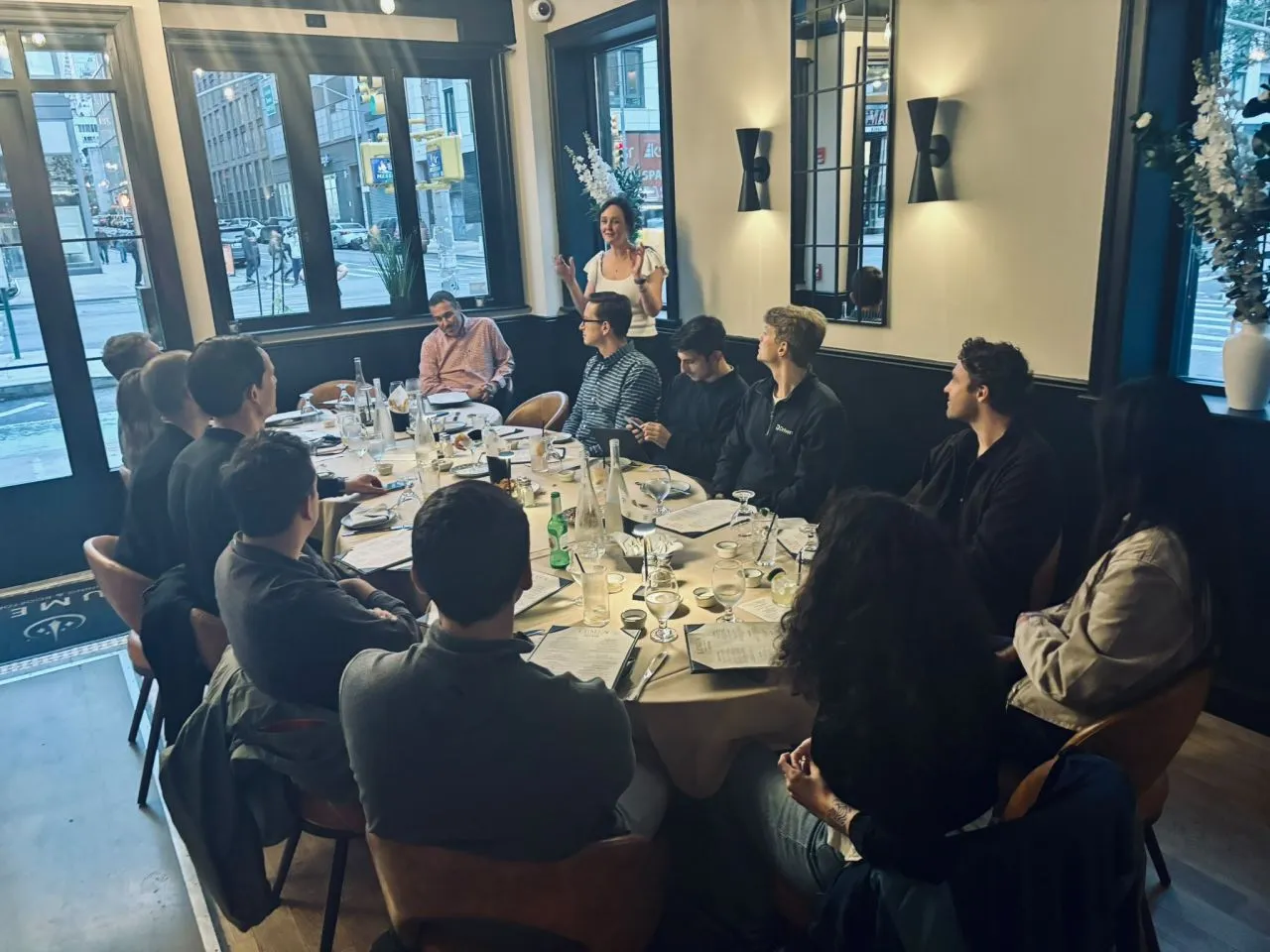
At the summit, my talk focused on helping teams make sense of how their business is doing through three metrics: MRR growth rate, NRR, and CAC payback. The point was one that felt relevant to the founders and revenue leaders we’d met throughout the series. People can hit their individual targets while the business stalls. Giving them a clear view of growth, retention, and acquisition costs helps them understand where their work can make a difference.
Thanks for coming
A year ago, I wanted to hear more from people doing the day-to-day work. Across seven cities, so many of you made time to share an experiment, ask a difficult question, or help someone think through a problem you’d faced yourself.
Thank you to everyone who joined us, and to the speakers, hosts, and teammates who made it happen. I hope you went home with a useful idea and someone new to call when you get stuck.